In this chapter, there are four key terms:
- Employed - working for pay
- Unemployed - not working but actively looking for work
- Out of the labor force - not doing paid work and not looking for work
- Labor force - employed + unemployed
Unemployment Rate
The unemployment rate is calculated by the following formula:
Those who are out of the labor force are not included in this rate.
Certain people who are employed part time or in temporary positions who may be looking for full time or permanent employment are counted as employed. Underemployed individuals are people who are trained for a certain type of labor, yet take on a lower paying job or one in which they cannot fully utilize their skills. Discouraged workers are people who are not counted as unemployed due to their not looking for work. These are hidden forms of unemployment.
Participation Rate
The labor force participation rate is an important metric that measures the number of adults in the labor force divided by the total adult population.
Unemployment Patterns
Key patterns of US unemployment:
- Rates fluctuate over time
- Rates never reach zero
- Rates follow economic movements
- Rates do not trend upwards or downwards significantly
Group Patterns
- Unemployment rates for women tend to be higher than rates for men, although the gap is narrowing
- Younger workers are unemployed at higher rates than middle-aged workers
- Blacks are significantly less employed
- Lower educated individuals are less employed
Comparing unemployment between countries is difficult, as methodologies differ as well as the quality of data. Cultural and government differences must also be taken into account.
Changes in Short Run Unemployment
Cyclical unemployment is the variation in unemployment due to recession. Firms hire more when they believe there will be more business, and vice versa.
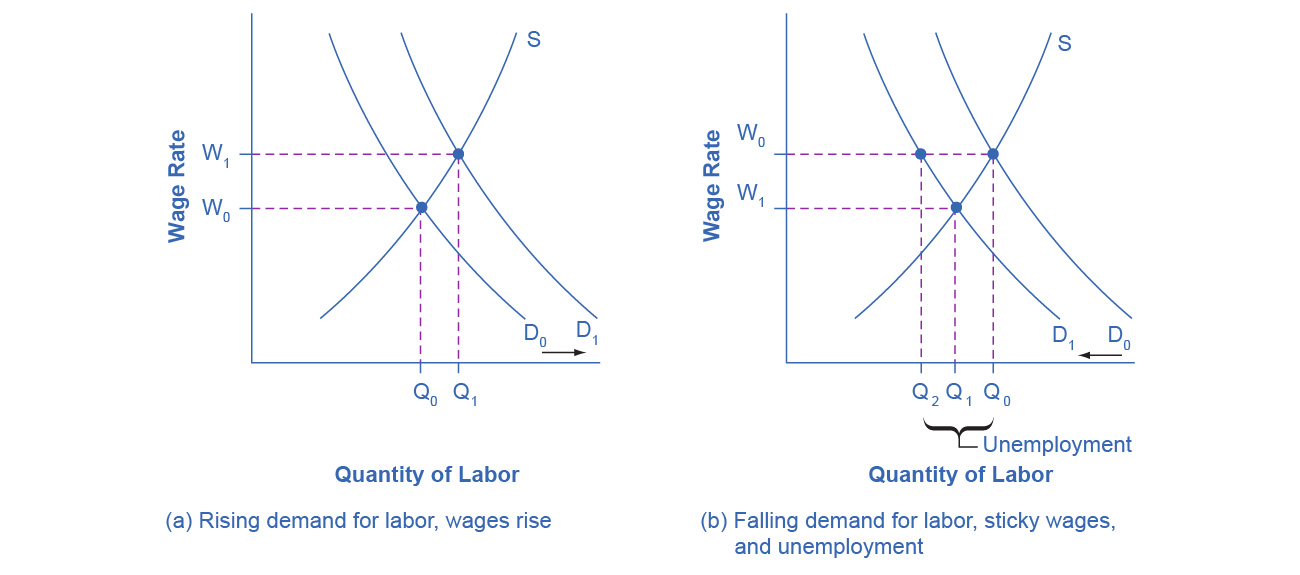
Labor quantity and wage rate can be modelled with a simple supply and demand curve, meeting at an equilibrium wage and quantity.
Individuals whom would only work at a wage above the equilibrium are counted as unemployed although they are arguably choosing not to work at the market price.
Sticky Downward
Sticky downward refers to the tendency of wages to easily increase, but not decrease. This can be due to minimum wages, union contracts, and other factors.
For instance, there may be an implicit contract between non-union employees and employers that during a weak economy, employees do not expect increases in pay while the employer attempts to maintain the current level. This acts as insurance against falling pay, keeping workers productive.
The efficiency wage theory describes how worker productivity is dependent on pay, incentivizing employers to pay above-market wages to motivate workers and prevent them from leaving, minimizing the costs associated with replacing workers.
The adverse selection of wage cuts argument argues that the best workers will leave for competing firms, while the worst are likely to stay when wages are reduced. Therefore, firms utilize layoffs to choose who stays or leaves. Reducing a firm’s workforce may be a more attractive option compared to a wage decrease.
The insider-outsider model describes current employees as insiders and new hires as outsiders for a period, where insiders keep the firm running smoothly. Reduced wages would result in the leaving of some critical insiders.
The relative wage coordination argument argues that although most individuals would be willing to take a pay cut, decentralized economies do not have mechanisms to coordinate a decrease. Thus, workers who see a cut in pay assume that they would be relatively worse off compared to other workers, so they fight against cuts.
Economists believe if wages fall in an economy, it happens slowly. Inflexible wages lead to short-run or long-run unemployment.
 |
|---|
| Economists believe if wages fall in an economy, it happens slowly. Inflexible wages lead to short-run or long-run unemployment. |
Changes in Long Run Unemployment
Unemployment “naturally” occurs in the long run due to many factors, whether they be economic, social, political, or otherwise.
Frictional unemployment refers to the unemployment as a result of workers moving in between jobs, as workers cannot be instantaneously matched with employers. Frictional unemployment can be lower if it is easier for workers to find jobs.
Structural unemployment refers to people who are unemployed because they lack the skills that the market is seeking, or possess skills that are out of demand. For example, telephone operators faced unemployment due to electronic switching.
An economy is at full employment when the actual unemployment rate is equal to the natural rate. The economy’s real GDP is equal to its potential real GDP at this rate. Real GDP may be greater than potential real GDP, but only for a short period of time due to overworking.
Productivity Shifts
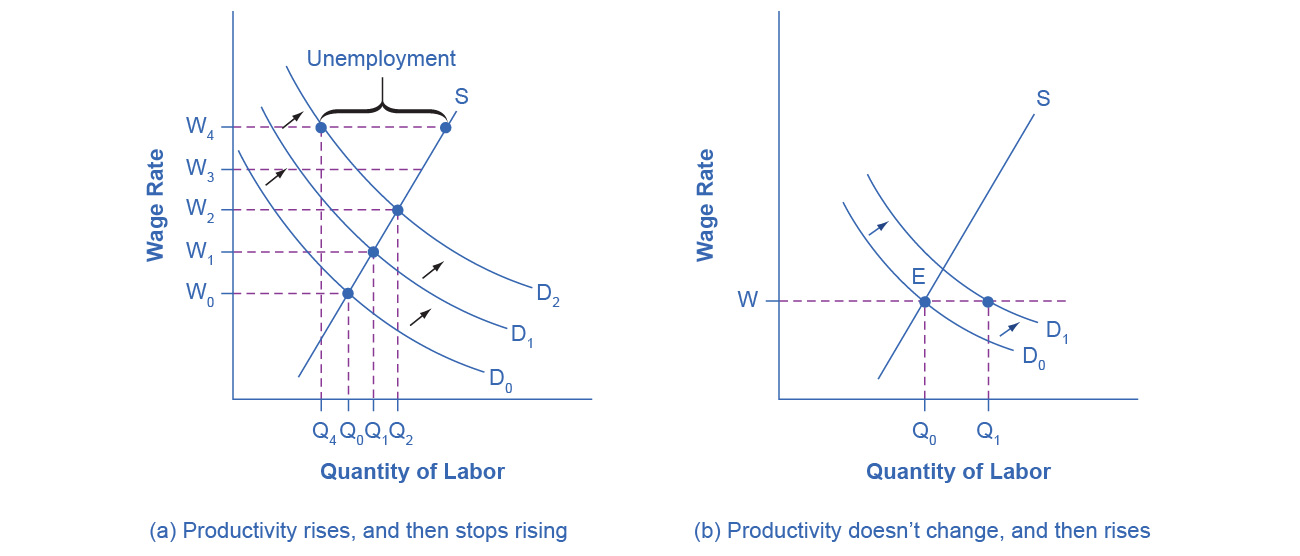
The natural rate of unemployment can be affected when there is an unexpected change in productivity. This is because productivity is observed in terms of past trends, making it hard to respond to current conditions.
 |
|---|
| Increased productivity leads to an outward demand shift, leading to an increased equilibrium wage. When productivity fails to increase at the same rate, the quantity demanded at the trending wage falls short of supply, resulting in unemployment. |
Government policy affects unemployment. Labor protections discourages firms from hiring more than the bare minimum, and barriers to business discourages hiring.
The natural unemployment rate is subject to change. For example, the internet has made it far easier to find jobs compared to the past, lowering the natural rate. European countries with strong welfare programs and government benefits see a higher rate compared to the US.